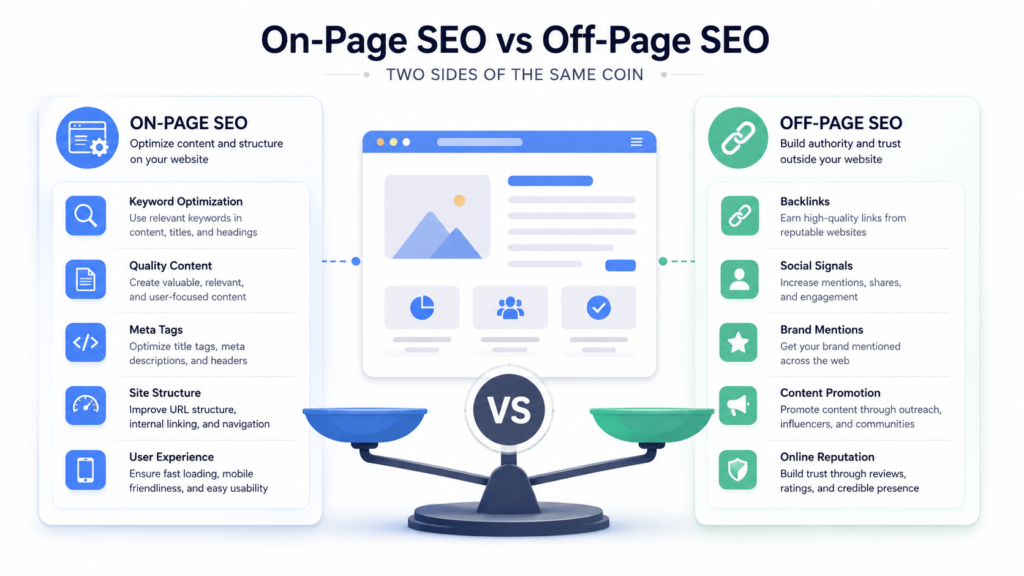
If you have ever wondered what is the difference between off-page SEO and on-page SEO you are not alone. In fact that is one of the questions that business owners ask me most often when their web page is not performing as desired.
During one recent SEO audit I came across a recurring theme that seemed to prevent pages from ranking. Everything looked good on the page. The content was informative enough, the site was quick to load and the page structure was good. But it turned out that the problem was in backlinks. An SEO audit allowed me to look at the bigger picture and truly understand the difference between on-page and off-page SEO
I will share with you what I discovered and explain why off-page SEO is so important for your website. Furthermore, I will also give you some valuable SEO tips and guidelines for solving both on-page and off-page problems.
What Is On-Page SEO?
Table of Contents
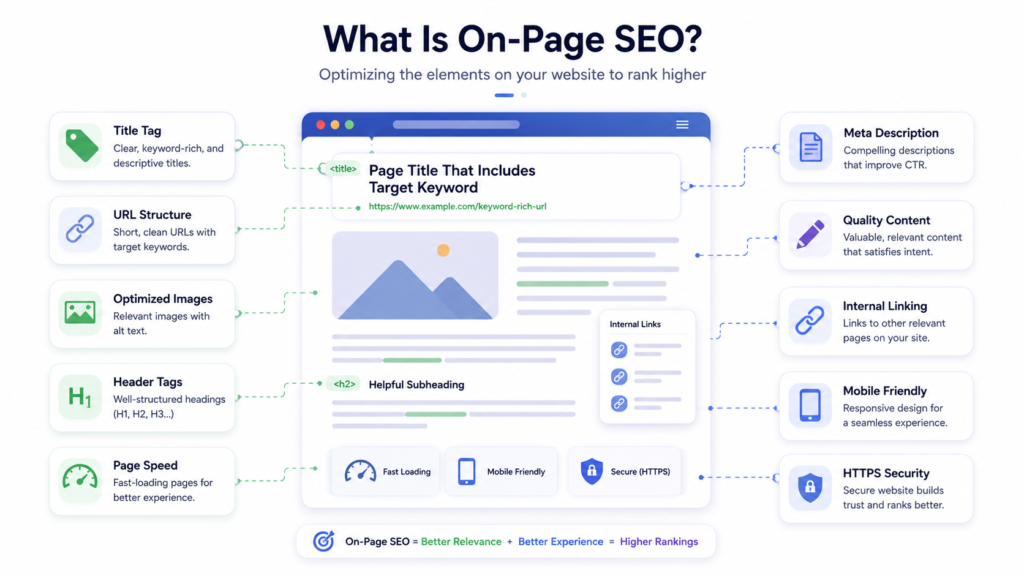
On-page SEO factors are elements within your control on your own website. These include content, title tags, headings, internal links, page speed, mobile-friendliness, and relevance to a given query.
In short, on-page SEO encompasses all factors affecting a single page’s appearance, performance, and relation to search intent, or what a visitor is searching for. It may also be referred to as “on-site SEO.”
What Is Off-Page SEO?
Off-page SEO is everything that happens away from your website that still affects how it ranks. This mostly means backlinks — other websites linking to yours — along with brand mentions, local citations, reviews, and general online reputation.If on-page SEO is your shop’s interior, off-page SEO is its exterior – which means word-of-mouth, referrals, and credibility with the rest of the marketplace. Google reads both, and on-page SEO tells Google what your site is about, and off-page SEO tells Google who you are – and how much it should trust your word.
The Shop Analogy: The Simple Explanation for On-page and Off-page SEO Differences
I use the shop analogy with almost every client I speak to on the first few meetings.
Think of your website as a shop. Your on-page SEO is everything about keeping the shop clean and organized. It’s the signs that guide the visitor to the right section, the staff that helps them find what they need, how the products are organized on shelves – your content, copy, architecture and much more. Everything that happens inside your shop in terms of optimization falls under the on-page category.
And now imagine that there is a shop down the street that is less organized and has a less friendly staff. If people prefer to visit this chaotic place over yours despite the poor quality of service and products, that is off-page SEO. It’s word-of-mouth marketing and the number of mentions your website has across other platforms like local listings, directories, and media outlets. Think of it as “reputation management.”
A clean but poorly reviewed shop will have a hard time attracting customers, just like we saw in our audit example.
On-Page SEO vs Off-Page SEO: Comparison Table
| Factor | On-Page SEO | Off-Page SEO |
|---|---|---|
| Where it happens | Directly on your website | Outside your website |
| What it controls | Content, titles, headings, internal links, page speed, UX | Backlinks, brand mentions, citations, reviews |
| What it signals to Google | What the page is about | Whether the site can be trusted |
| Who controls it | You, directly | Partly you, partly earned through others |
| Typical fixes | Rewrite content, improve structure, fix technical issues | Earn links, build citations, reclaim broken backlinks |
Real Example: When On-Page Was Not the Problem
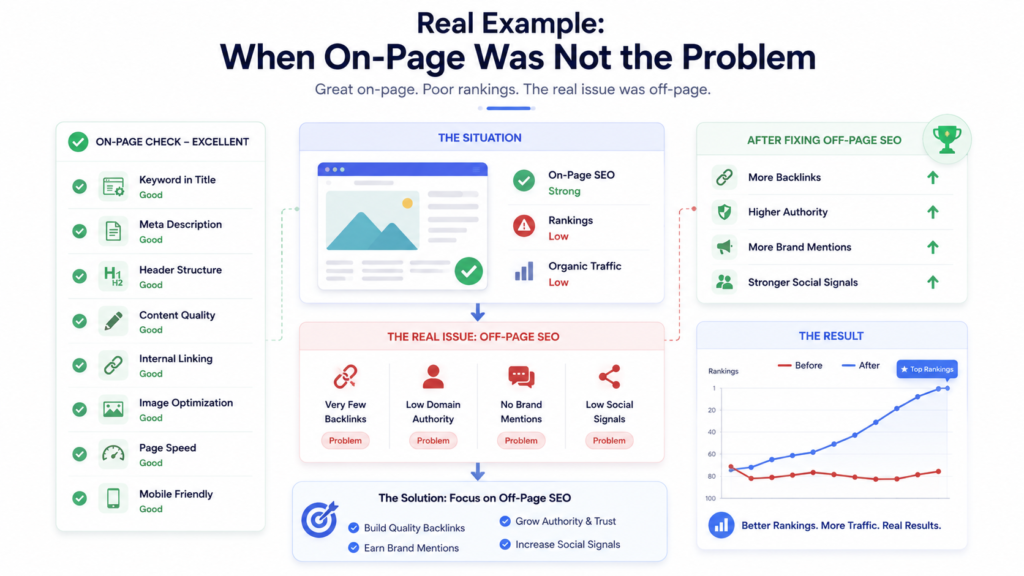
While performing an SEO audit for one small business, we have identified that the website has too few relevant backlinks and too many low-quality directory links. The on-page optimization was okay, so there was not much we could do to improve the rankings by making changes to the site’s pages. However, there were several things we could do:
- build relevant backlinks
- optimize local citations
- recover lost backlinks
- And create content that would gain backlinks.
Over the following months, referring domains increased, keyword rankings improved, and organic traffic grew. Nothing on the page itself had changed much — the shift came entirely from off-page work.
What Happens When You Only Focus on One Side
I have seen the mistake happen in both ways, and I think it is a good idea that you understand what could happen.
Strong On Page SEO, Weak Off Page
The website is up,has good content,is targeting keywords,loads fast,and is mobile-friendly.
However, there are few backlinks or quality links.
Google will be able to read the website fine, but will not be able to tell that the website is trustworthy compared to others .
Strong Off-Page SEO, Weak On-Page SEO
An illustration of this situation may be an organization with numerous backlinks and mentions on external platforms but with poorly created pages. They may lack the necessary content or it may be low-quality, making the user experience on the website unpleasant or uninformative. In other words, the company has a strong SEO from the outside, so they attract traffic from search engines, but the weakness of internal SEO makes them unable to retain visitors, which ultimately means that the site will not appear in the first pages of search results and, therefore, the company’s rating will be low.
Thus, the simplest answer to the question of why search engine optimization is important for the page that I sometimes give my clients is that engines need to understand what the page is about, so they need to know that the company knows what it is talking about. In other words, it is necessary to have both types of SEO to increase traffic and, consequently, the rating.
How Long Until Results?
This is the first question any client asks, so it is my favorite; I think it is also one of the most critical questions.
2-6 weeks – Google finds new backlinks and recrawls the pages, so you may notice some minor changes, but nothing significant.
2-4 months – If you optimize the page correctly and build high-quality backlinks, keywords with moderate competition start ranking.
4-12 months – For highly competitive niches (web design, digital marketing, etc.), it takes longer to rank for relevant keywords with considerable traffic.
It is seen most of the times that local clients tend to get results faster than the ones on a national level. So, while your friend is searching for something generic like best SEO companies in Alappuzha, your local competitors targeting “SEO Services in Alappuzha” will stand a better chance at a higher position than those targeting “what is off-page SEO”.
The truth I tell all my clients is that SEO is an investment that needs to be made with patience, and although it is possible to see some early fruits within the first few weeks, it is only after 3-6 months that you start to see considerable improvements, and a further 6-12 months for competitive keywords.
Q&A
What one is better off page SEO or on page SEO? None of them is better because they all satisfy specific criteria. The content that is not authoritative enough will not get high ranking while the absence of optimization of the authoritative site will make it impossible to use authority
What should one do in order to improve off-page SEO activities fast?
It can be achieved through getting quality backlinks from relevant web pages, getting rid of any broken links that one might have and being consistent in citations and reviews.
Can a recently launched website achieve good ranking through off-page SEO activities only?
Not really, particularly if the keyword is very competitive. The website must have some aspects of on-page SEO
Conclusion
On-page SEO and off-page SEO don’t go against each other; they complement each other. On-page SEO enables search engines to understand your site. On the other hand, off-page SEO enables them to trust your site. Focusing solely on one means you are missing out on rankings.
Start by auditing both of them in earnest: do you have quality content and site architecture, and does your site deserve that much credibility?